

As the European population gracefully ages, the demand for personalized, high-quality care in assisted living facilities is soaring. Alongside this growing need is a dedicated but severely stretched workforce of care professionals. The combination of an aging population and a shortage of care professionals is creating an urgent demand for scalable personalized care in assisted living. However, meeting the diverse needs of end-users, like seniors who are unfamiliar with complex technologies, is a critical challenge.
While recent advances such as chatbots have improved verbal interaction, interactions between humans and robots are still often unintuitive. They rely on traditional input methods like keyboards and are designed for trained experts. In reality, people communicate differently. They speak, gesture, pause, hesitate, or adjust their posture. This is especially true in rehabilitation and exercise contexts, where movement itself is part of the interaction.

Getting Fit
EMBRACE builds on this. Our main objective with EMBRACE is to develop an HRI-enabled solution that leverages multimodal communication and is specifically designed with and for older adults in the assisted living sector.
The goal is to help older adults to stay fit with an exercise & rehabilitation HRI enabled companion that supports multimodal interaction. Regular physical activity in older adults is strongly associated with improved cardiovascular health, maintenance of muscle strength and balance, and reduced risk of falls, while also contributing to cognitive function and overall mental well-being. In addition, combining physical and cognitive tasks has been shown to support neuroplasticity and delay functional decline.
Co-designing with Real Users
A central part of EMBRACE is designing together with residents and care professionals, not just for them. This helped shift the focus from features to usability in practice. Small details, such as how instructions are delivered or how feedback is timed, proved critical for acceptance. Another key insight was that new systems are more easily adopted when they build on familiar setups rather than introducing entirely new interfaces. From our interviews, we learned that unfamiliar interfaces can create scepticism, so we designed the system to integrate with existing infrastructure, like a standard TV display that seniors already know and trust. At the same time, solutions need to remain flexible and affordable for assisted living environments. So we made sure that our architecture is modular and can work with different sensors, so is compatible with locally available equipment to reduce deployment costs for facilities.

Keeping the Human in the Loop
EMBRACE is designed to support interaction without removing the role of care professionals. Caregivers can define and oversee activities, while the system guides users through exercises independently. This creates a balance between autonomy and oversight, where residents can engage at their own pace while caregivers remain informed and in control. In practice, this approach contributes to a sense of safety and trust, which is essential for acceptance in care environments.
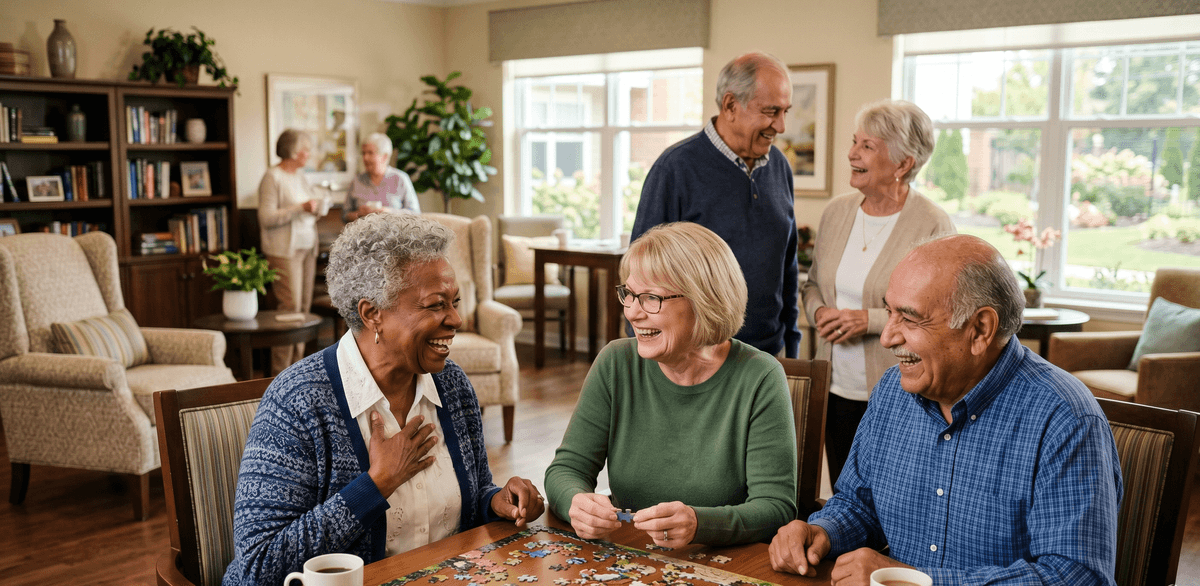
It’s all about Fun and Games
Maintaining engagement over time is one of the main challenges in training & rehabilitation. EMBRACE addresses this by integrating multimodal interaction and feedback directly into the exercise flow, helping sessions feel more varied without increasing complexity. A key part of this is supporting more natural communication, including the use of gestures as part of the interaction. In addition, the system includes gamified elements that make exercises more engaging. In our interviews, participants often expressed a preference for a more playful and enjoyable experience during training, which helped inform this design direction
Building for Real-World Deployment & Contributing to the Community
For deployment in assisted living, privacy and trust are essential. EMBRACE therefore processes all data locally on edge hardware, ensuring that sensitive information remains within the care environment and does not leave the premises. This approach supports compliance requirements while also addressing a key concern for both residents and care providers.
EMBRACE is part of the ARISE project, a European initiative developing an open-source, real-time enabled middleware for human-robot interaction. The project focuses on making industrial HRI more agile, interoperable, and easier to deploy across different environments, following Industry 5.0 principles of human-centric and collaborative systems. It builds on open technologies such as ROS 2 and related standards, including ROS4HRI and FIWARE, to support seamless integration and reusable components across applications.
As part of our contribution, we have released two reusable ROS 2 skills for the community. Given that body language is a key component of multimodal communication, these modules focus on gesture and posture detection as core perception capabilities. In particular, we prioritise high-impact gestures and postures that meaningfully extend existing systems with richer multimodal interaction.
Both modules are aligned with the ROS4HRI standards and are designed to be configurable, enabling adaptation to the specific requirements of different deployment contexts. The modules are available in the following GitHub repositories:
